
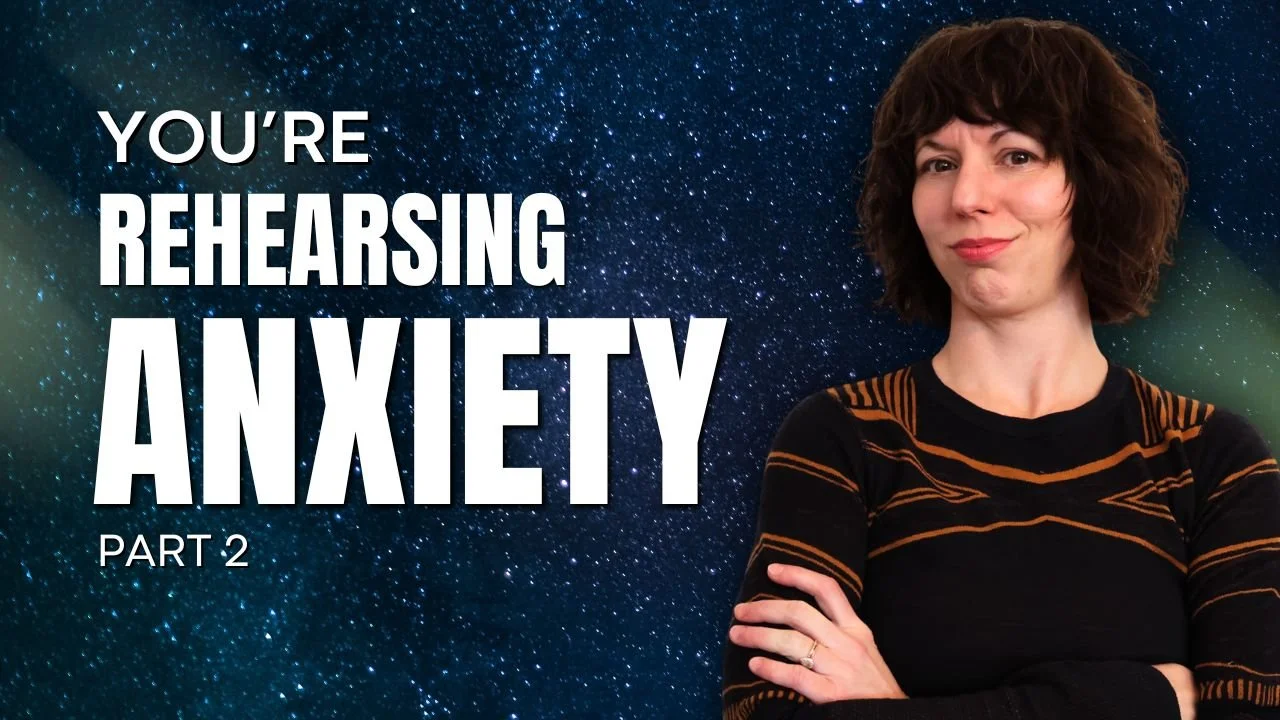
Why? Why is this happening to me? Why is this happening right now?
If an anxious thought has ever sent your mind racing through those exact questions, pause here. For highly sensitive people prone to overthinking, the urge to figure out anxiety feels responsible. Smart, even. Yet the very moves we make to shrink anxiety can quietly feed it.
Most of us were never taught the difference between caring for anxiety and rehearsing it. So we rehearse. Over and over, until the nervous system knows the routine by heart.
How Highly Sensitive People Rehearse Anxiety Without Realizing It
Avoidance is the classic example. We steer around whatever stirs up anxiety and expect relief. It backfires. Instead of strength training for calm, for peace, for grounded presence, highly sensitive people often end up practicing anxiety almost constantly.
Then the critical voice arrives with commentary. I'm trying so hard. I'm reading the books, listening to the episodes, talking about it, doing all the things. Nothing is working. Desperation creeps in, and right behind it comes helplessness. "I can't help how I think." "This is just my personality." "I'm a highly anxious person, and that will never change." Do any of those lines live in your head? Each one feels like a fact, and each one keeps anxiety’s grip tight.
Anxiety Is an Outdoor Cat
Feed an outdoor cat once and it sticks around. Feed it again and it cries louder at the door, wants more food, wants to come inside, then wants to sleep in your bed. Anxiety works the same way, and every anxious thought you chase sets another bowl out on the porch. Lovely if you're hoping for a new kitty, not so lovely when the kitty is anxiety.
You Don't Choose the First Anxious Thought
The first anxious thought may simply pop up, uninvited. Your power sits in what happens next.
Overthinking Turns Anxiety Into an Investigation
The feeding usually happens like this.
An anxious thought arrives. You feel the flutter in your chest, and immediately you ask the most logical question in the world. Why?
The question sounds reasonable. Psychologically, it does something sneaky. Asking why implies an explanation is waiting somewhere, and that finding it is your job. So the overthinking mind gets to work:
Maybe it's work.
Maybe it's my marriage. Is my partner hiding something? A secret credit card?
Is my health okay? My stomach has been grumbling all day. Could this be an ulcer?
What did I forget today?
This feeling has to mean something.
Before long, the original anxiety has become an investigation into anxiety. The more you look for anxiety, the more anxiety you find. Every why is another bowl on the porch. By the end, you're so worked up you can't tell up from down, much less choose your next wise move.
Highly sensitive people love solving problems. Puzzles, strategy games, tinkering until something finally clicks. That satisfaction is real. With anxiety, though, there may be no problem to solve right now. The honest answer to why might be that anxiety has lived in you since your inner child was small. Your nervous system knows this pathway well, and the tiniest cue can set it off before your conscious mind notices anything at all.
Watch for the twist that catches so many overthinking sensitives. Hearing there may be no problem to solve, the mind turns THAT into a brand new problem. Oh no, there's no problem for me to fix! Yes, that pattern is exhausting. A pattern is very hard to change when you can't see it, so naming it is the first step.
The intervention is witnessing without fixing. If even a grain of anxiety is in your body right now, try this. Place a hand on your heart, take a deep breath, and say to yourself:
I notice and accept that I feel anxiety right now.
Then breathe again. Notice the frequency of those words. Underneath them sits a quieter message: I'm safe. I'm grounded. I won't spin. Compare that to treating every flutter as a five-alarm emergency. Witnessing first helps regulate the nervous system, and if there is something to do, you get to decide it from a grounded place.
Think about what you do when a baby cries. Most highly sensitive people would scoop that baby up without a second thought. You'd hold it close, tightly yet gently, and murmur, it's okay, sweet baby, I've got you. You might rock it, hum, sing. You wouldn't need a manual. You wouldn't need to know why the baby is crying before offering comfort. That is co-regulation, and you already know how to do it.
For people pleasers, this lands hard. In codependency recovery, we say people pleasers give away what we most need. You would offer this comfort to any random baby in a heartbeat. Your inner child, the scared and anxious parts of you, is waiting for the same scoop and hold. From you.
Witness as if witnessing is everything. As if it carries every benefit of every technique ever created. If digging into the root of your anxiety ever becomes wise, you can do it later. Most of the time it won't be necessary. Anything important will make itself known.
Could you witness yourself with that kind of fullness?
Build an Anxiety Protocol for Your Nervous System
Overthinking wants a culprit. Many highly sensitive people do far better with an anxiety protocol, a simple set of moves to slip into every time anxiety washes over. Do you have one? What does your nervous system actually need in those moments?
Take a slow, full breath
Walk, move, or dance
Eat something
Step outside, or step inside if you're already out
Rest your eyes on the shapes of a plant's leaves and let your breath slow
Press bare feet onto the ground
Sleep on it, and see how things look in the morning
None of these steps involve research or investigation. Over time, your inner child watches you follow the protocol, learns to trust you, and stops sending up so many alarms.
Accepting Anxiety Means Less Anxiety
Some folks hear all this and bristle: so I'm just supposed to accept that I feel anxious? Yes. The more we fight the reality that anxiety is part of life, the more anxiety shows up, and the more we accept it with a protocol ready, the more our inner child relaxes. You'll find you need that protocol less and less.
Capacity Is the Goal for Highly Sensitive People
Medication can reduce symptoms. It cannot teach capacity. You are allowed to weigh whether side effects are worth it for you, and you can find your personal power whether or not medication is part of your care.
Real healing grows capacity, and capacity grows in every direction at once. More capacity to sit with anxiety means more capacity for joy, laughter, satisfaction, creativity, hobbies, going with the flow, facing fears, and chasing dreams. Less overthinking leaves room for all of it. You may feel beaten down by anxiety right now, and that feeling is real and valid. Your influence over your nervous system is still enormous, one thought and one choice at a time.
Affirmations for Anxious Thoughts
Try these the next time anxious thoughts start crying at the door.
I notice and accept that I feel anxiety right now.
I don't have to solve this to be safe.
I can comfort my inner child the way I would comfort any crying baby.
My power lives in what I choose next.
Light and love, y'all.
Episode Tags
- ADD 1
- Abuse 17
- Alcohol 3
- Anger 11
- Archetypes 1
- Bullying 6
- Childhood 38
- Codependency 11
- Covid 4
- Crystal Catalina 4
- Depression 15
- Detachment 2
- Disassociation 4
- Discomfort 1
- Emotions 75
- Existentialism 2
- Faith 1
- Family 28
- Fatigue 4
- Focus 3
- Gratitude 12
- Grief 14
- Guilt 2
- Healers 7
- Healing 52
- High Sensation 4
- Hope 1
- Hypervigilance 7
- Introverts 6
- Lonliness 10
- Love 3
- Manifesting 5
- Manipulation 20
- Masculinity 1
- Men 1
- Mindfulness 39
- Money 10
- Music 3
- Nutrition 2
- Overthinking 8
- PTSD 13
- Parenting 12
- People Pleasing 10
- Perfectionism 8
- Pets 4
- Relationships 23
- Resiliency 14
- Sadness 1
- Self Esteem 19
- Self Love 11








Episode Tags
- ADD 1
- Abuse 17
- Alcohol 3
- Anger 11
- Archetypes 1
- Bullying 6
- Childhood 38
- Codependency 11
- Covid 4
- Crystal Catalina 4
- Depression 15
- Detachment 2
- Disassociation 4
- Discomfort 1
- Emotions 75
- Existentialism 2
- Faith 1
- Family 28
- Fatigue 4
- Focus 3
- Gratitude 12
- Grief 14
- Guilt 2
- Healers 7
- Healing 52
- High Sensation 4
- Hope 1
- Hypervigilance 7
- Introverts 6
- Lonliness 10
- Love 3
- Manifesting 5
- Manipulation 20
- Masculinity 1
- Men 1
- Mindfulness 39
- Money 10
- Music 3
- Nutrition 2
- Overthinking 8
- PTSD 13
- Parenting 12
- People Pleasing 10
- Perfectionism 8
- Pets 4
- Relationships 23
- Resiliency 14
- Sadness 1
- Self Esteem 19
- Self Love 11
Recent Episodes:

Upcoming Events


For the Highly Sensitive Person who wants meditation without distraction. No intros, no explanations, no outros. Just you, Nikki, and meditation. This pack includes 6 separate tracks and over and hour of audio meditations in HD quality. Using mindfulness, we focus the mind and train your attention and awareness, to achieve a mentally clear and emotionally calm and stable state. Meditation may help reduce stress, anxiety, depression, and pain, and enhance peace, perception, self-concept, well-being, and improve our overall mental-health.
*All files are 320k/MP3 format.
Coping Strategy for Stress and Flow (11:52)
Overcoming Bullying Meditation & Mantra (13:10)
Forest Meditation - An immersive nature experience (22:13)
Cultivating Safe Space Within (19:21)
The Space Between Meditation (10:16)
Binaural Beats Brain Wave Trance Experience (14:02)
*Bonus - Binaural Beats Brain Wave Trance Experience - Instrumental Version (14:02)