What else is true?
When pain shows up, that question can feel almost rude. You're hurting. Someone said the wrong thing, a plan fell apart, a door closed, and every cell in your body is locked onto the hurt. For highly sensitive people, that locking on happens fast and runs deep.
Perspective is the ability to zoom out far enough to see more than the feeling, the fear, the insult, the disappointment, or the moment you're standing inside of. For highly sensitive people, perspective is protective. It keeps pain, fear, or old trauma from shrinking your whole world down to tunnel vision.
Why Highly Sensitive People Lose Perspective
Highly sensitive people take in more information. We're spongy. We notice nuance, feel deeply, and process for a long time after something happens. One scientific theory holds that sensitive people have more mirror neurons, which helps explain why another person's mood can land in your body like your own.
That depth is a gift. It is also a weight. Without perspective, the gift narrows into tunnel vision. One painful interaction suddenly feels like the whole relationship. One mistake becomes evidence of who you are. One hard season starts to feel like your entire life, and your nervous system braces as if every season ahead will be just as hard. Funny thing for people who live in nuance: when panic hits, we grab the biggest brush in the room and paint everything with it.
Perspective Adds Information to Your Pain
Perspective never asks you to minimize pain, bypass reality, or talk yourself out of what you know for sure. Healthy perspective simply adds useful information. Your hurt stays real, and it gets company from everything else that is also real.
What Else Is True When Pain Takes Over?
When intensity hits, the story maker in your head grabs a feeling and runs with it. Yes, this hurts. Yes, you're angry, maybe disappointed. Yes, someone behaved poorly. All of that can be true, and those truths can still harden into tunnel vision. Asking what else is true helps you zoom out without erasing any of it.
Once the lens widens, more questions open up:
What is still good?
What is working instead of what isn't?
What do I still have instead of what I lost?
What information am I forgetting while pain grabs all my attention?
Will This Matter in a Year? Giving Pain Only the Space It Deserves
Feel this question in your body: will this matter in a year? Not could it matter, and not what catastrophe your mind can build. Some things absolutely will, but most things that hijack the nervous system won't. Caring about something doesn't require handing it miles and miles of emotional real estate or 500 acres, and plenty of problems deserve a one-by-one-foot patch of ground, just the spot where you're standing and no more.
When Trauma Shrinks the View: Responding to What's Happening Now
Am I responding to what is happening, or am I responding to everything this reminds me of?
Highly sensitive people rarely experience life in isolated moments. Things connect to other things. Your nervous system learns, which is beautiful and burdensome in equal measure.
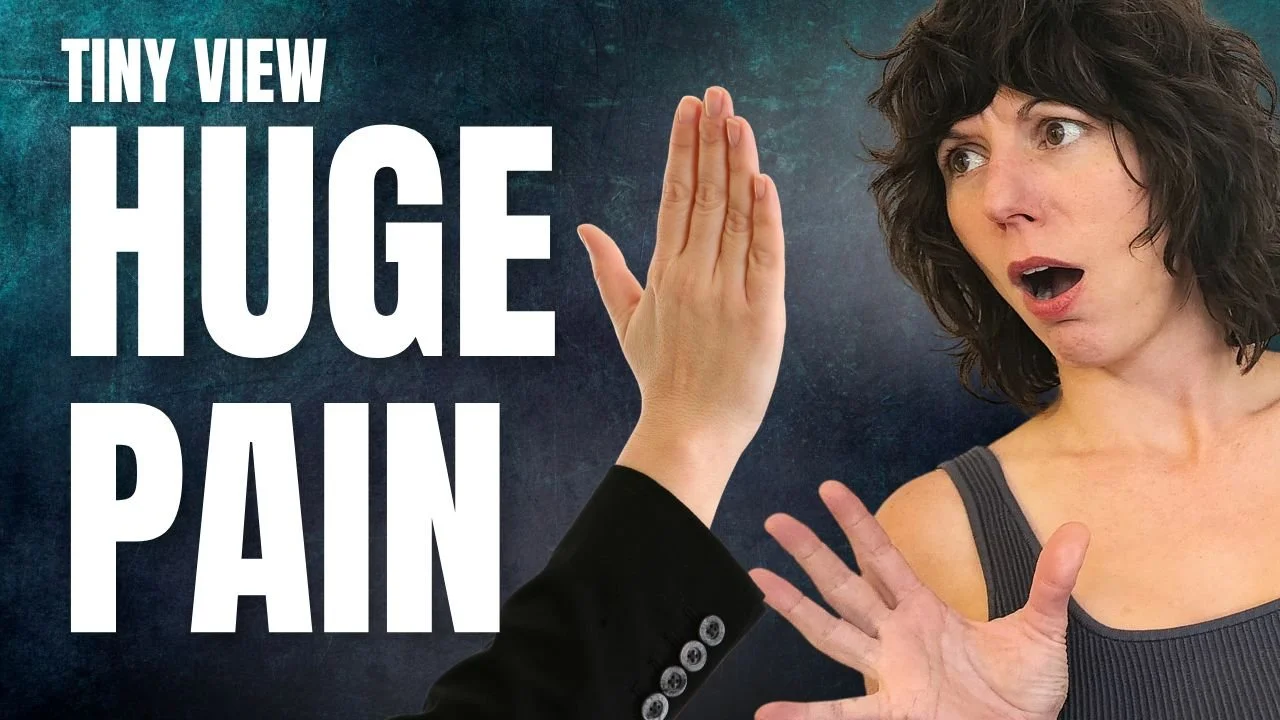
Imagine growing up with someone who bopped you on the forehead every time you walked into a room. Years later, you walk into a room with a brand-new person who raises a hand for a high five. Before a single cohesive thought forms, your body reacts as if a bop to the forehead is coming. The person with the raised hand is confused, because hitting people in the forehead was never part of the plan. In one tiny movement, a trauma survivor can feel ten years of experience wash over the body, then has to find a way back to the present while another human stares, wondering what just happened.
Betrayal trauma makes this especially tricky. A car accident, a lightning strike, a flood, or a house fire can be devastating, but no human set out to manipulate, use, or abuse you. When the injury came from people, people become the trigger.
Say a solid, trustworthy person in your life gets mad and says something word for word like an abuser from your past. Your nervous system floods with hypervigilance. That response is smart. It learned that phrase means watch out, abuse is coming. Still, the present moment deserves to be met as the present moment.
Every human being, every single one, says and does things that can look narcissistic in a snapshot. A selfish moment. A foot-in-mouth moment. A popped-off, didn't-contain-it-well moment. Real narcissism, along with real energy vampires, manipulators, and abusers, means a pervasive, persistent, overarching pattern of being. Narcissism is never a one-off.
This part stings. Surviving horrific things doesn't buy a free pass. Trauma survivors don't get a life path cleared of every trigger and obstacle just because the early path held so many. If the universe were fair, maybe it would work that way. Your adult self knows fairness isn't part of this equation, and you don't have to spend energy vying for what isn't available.
Some things get to be non-negotiable. Some things happen once, and you leave. Life is still a dance, and we need other flawed humans who make mistakes and then clean up the messes. Hard doesn't mean traumatic. A moment of pain with a good person can hurt without breaking anything beyond that moment.
So ask yourself: how much of this belongs to RIGHT NOW? That question loosens tunnel vision. It acknowledges that the past is past, done and over, even when your nervous system hasn't caught up. It helps your inner child learn that exhausting hypervigilance can finally retire. The now might still be uncomfortable, disappointing, even hurtful. You get to deal with the present moment instead of the present moment with decades piled on top.
I can respond to what is happening right now.
The past is over, even when my body forgets.
Hard doesn't mean traumatic.
Zoom Out on Your Inner Critic
If you were watching what's happening to you happen to someone else, what would you see differently? When we feel buried, suffocated, so deep in it, perspective becomes distance, and distance breaks tunnel vision fast. Catch yourself mid self-shaming extravaganza, calling yourself a dumb ass over one mistake, and ask: would you say that to a five-year-old? Would you think that about anyone else who was trying this hard? The shift is almost always immediate! Damn. You wouldn't come close to saying this to another human being, especially someone you love. So why is it okay to say it to yourself?
Recovering codependents, people pleasers, and highly sensitive people give away what we most need to keep. Is it time to reserve some forgiveness, softness, kindness, and space for your own mistakes? When you require yourself to receive what you've been so freely giving away, the inner bully backs off and self-love takes the wheel.
Zoom Out to the Biggest View of Your Life
Zoom out past this conversation, this week, even this year, to your whole history and the whole unknown future. Who have you become, and who are you becoming? What have you survived, finished, and banked as a lesson you never have to learn again? What matters to you now that didn't in earlier seasons, and where are you going?
Perspective Reminds You This Moment Will Pass
This is a moment in your life. It is not your life. All moments pass, and this one is passing now.
Light and love, y'all.
Episode Tags
- ADD 1
- Abuse 17
- Alcohol 3
- Anger 11
- Archetypes 1
- Bullying 6
- Childhood 38
- Codependency 11
- Covid 4
- Crystal Catalina 4
- Depression 15
- Detachment 2
- Disassociation 4
- Discomfort 1
- Emotions 75
- Existentialism 2
- Faith 1
- Family 28
- Fatigue 4
- Focus 3
- Gratitude 12
- Grief 14
- Guilt 2
- Healers 7
- Healing 52
- High Sensation 4
- Hope 1
- Hypervigilance 7
- Introverts 6
- Lonliness 10
- Love 3
- Manifesting 5
- Manipulation 20
- Masculinity 1
- Men 1
- Mindfulness 39
- Money 10
- Music 3
- Nutrition 2
- Overthinking 8
- PTSD 13
- Parenting 12
- People Pleasing 10
- Perfectionism 8
- Pets 4
- Relationships 23
- Resiliency 14
- Sadness 1
- Self Esteem 19
- Self Love 11








Episode Tags
- ADD 1
- Abuse 17
- Alcohol 3
- Anger 11
- Archetypes 1
- Bullying 6
- Childhood 38
- Codependency 11
- Covid 4
- Crystal Catalina 4
- Depression 15
- Detachment 2
- Disassociation 4
- Discomfort 1
- Emotions 75
- Existentialism 2
- Faith 1
- Family 28
- Fatigue 4
- Focus 3
- Gratitude 12
- Grief 14
- Guilt 2
- Healers 7
- Healing 52
- High Sensation 4
- Hope 1
- Hypervigilance 7
- Introverts 6
- Lonliness 10
- Love 3
- Manifesting 5
- Manipulation 20
- Masculinity 1
- Men 1
- Mindfulness 39
- Money 10
- Music 3
- Nutrition 2
- Overthinking 8
- PTSD 13
- Parenting 12
- People Pleasing 10
- Perfectionism 8
- Pets 4
- Relationships 23
- Resiliency 14
- Sadness 1
- Self Esteem 19
- Self Love 11
Recent Episodes:
Upcoming Events


For the Highly Sensitive Person who wants meditation without distraction. No intros, no explanations, no outros. Just you, Nikki, and meditation. This pack includes 6 separate tracks and over and hour of audio meditations in HD quality. Using mindfulness, we focus the mind and train your attention and awareness, to achieve a mentally clear and emotionally calm and stable state. Meditation may help reduce stress, anxiety, depression, and pain, and enhance peace, perception, self-concept, well-being, and improve our overall mental-health.
*All files are 320k/MP3 format.
Coping Strategy for Stress and Flow (11:52)
Overcoming Bullying Meditation & Mantra (13:10)
Forest Meditation - An immersive nature experience (22:13)
Cultivating Safe Space Within (19:21)
The Space Between Meditation (10:16)
Binaural Beats Brain Wave Trance Experience (14:02)
*Bonus - Binaural Beats Brain Wave Trance Experience - Instrumental Version (14:02)