
Small Habits, Big Change with Eric Zimmer author of "How A Little Becomes A Lot"
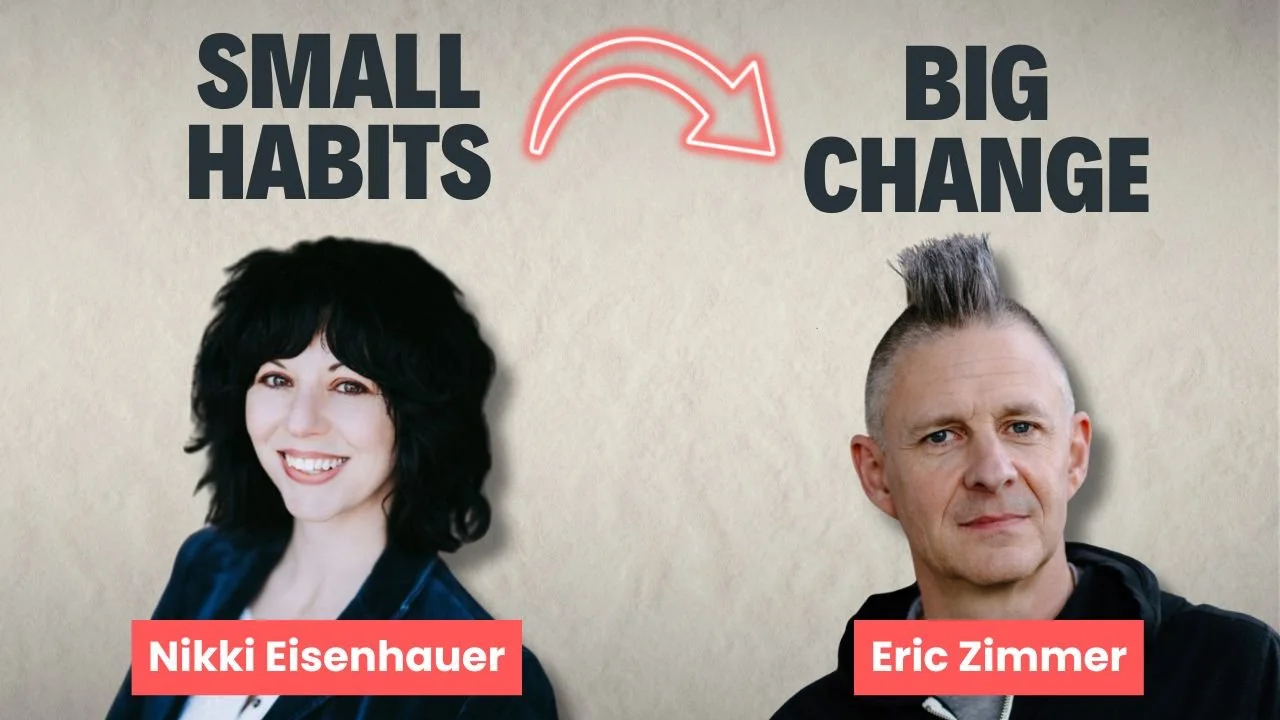
What happens when you set big goals, inevitably fail, and then conclude something is fundamentally wrong with you?
This cycle makes change harder each time. The pattern repeats: ambitious resolutions, unsustainable effort, collapse, and self-judgment. Small habits offer a different path forward.
Why All or Nothing Thinking Keeps You Stuck
All or nothing thinking creates a setup for failure. You decide to hit the gym five days a week, meditate daily, journal every morning, and overhaul your entire life simultaneously. When this pace becomes unsustainable, the conclusion feels inevitable: you lack discipline or willpower.
These beliefs about yourself make change harder next time. Self-doubt compounds with each failed attempt.
The alternative approach focuses on manageable actions rather than massive overhauls. Small habits build differently than grand gestures. They create space for self-compassion instead of self-criticism.
Building Belief in Yourself Through Kept Promises
Making and keeping promises to yourself changes everything. When you identify what you can actually do and follow through consistently, belief in yourself grows. Belief in your ability to change grows. Belief in your capacity to author your own life grows.
This creates what behavior change experts call a virtuous circle. Motivation increases when you feel good about yourself and your chances of success. Motivation drops when self-doubt dominates and you question your ability to succeed.
Starting with small habits that you can maintain daily builds this upward momentum. Each kept promise strengthens the foundation. Each small win proves change is possible for you specifically, not just in theory.
The Social Media Comparison Trap and Self-Worth
Social media functions as a comparison hellscape. You scroll through curated highlights and subconsciously convince yourself that others have it figured out while you fall short. You see people exercising, eating well, meditating, thriving—without understanding their full situation or struggles.
The constant measurement against impossible standards damages self-worth. Your brain processes these comparisons mindlessly, almost removed from conscious awareness.
Bringing this pattern into consciousness allows you to see it clearly. You cannot change what you cannot identify. Small habits require honest assessment of where you actually are, not where Instagram suggests you should be.
Self-Doubt Is Baked Into Growth (And That's Okay)
Self-doubt shows up every time you attempt something beyond your current abilities. This is not evidence of inadequacy. This is proof you are stretching toward growth.
Writing a book brought up levels of self-doubt that hadn't surfaced in decades for one author. The early drafts were not good. Objectively, measurably not good. The critical voice insisted: you cannot do this, you are not a writer, quit now before you embarrass yourself further.
But self-doubt does not need elimination. It needs volume adjustment.
You do not have to silence the doubtful voice completely. You just need to turn it down enough to start. Enough to take the next small step. Enough to make today's choice without solving next week's problems.
The choice point arrives daily. It's time to write, to exercise, to practice the new behavior. Self-doubt will be there. The question becomes: can you turn down the volume and begin anyway?
Perfectionism: The Sneaky Saboteur of Progress
Perfectionism disguises itself as helpfulness. It arrives whispering that it just wants you to be good at this thing, that it's protecting you from failure and embarrassment. Then it adds: you are not good enough right now, so why try?
This voice shuts down the ability to try. It paralyzes forward motion under the guise of protecting you from mediocrity.
Imagine telling a baby not to attempt standing because falling is inevitable. You would never speak that way to a child learning to walk. Yet this is exactly the internal dialogue many people maintain with themselves daily.
The reframe that helps: "I am not good at this yet."
Yet changes everything. Yet acknowledges current reality without foreclosing future possibility. Yet leaves room for growth and learning. Yet means the way to get better is not to quit, but to continue practicing despite imperfection.
Self-Compassion vs Self-Criticism: The Teacher Example
Picture two students answering a math question incorrectly.
Billy says four plus three equals eight. The teacher responds: "Billy, you are an idiot. Four plus three is not eight. You will never learn math. You will be lucky to get out of elementary school. Forget college."
Sally says four plus three equals eight. The teacher responds: "No, four plus three is not eight, it's seven. Here's why. I know you can do this if you keep trying, Sally. If you need extra help, come see me after class."
Which student learns math? The answer is obvious.
Applying this same logic to yourself does not require pretending four plus three equals eight. You do not have to deny reality or inflate your abilities. You can acknowledge what needs work while staying on your own side.
Self-compassion is not about lowering standards or accepting mediocrity. It's about creating the conditions where learning and growth become possible. Self-criticism creates paralysis and shame. Self-compassion creates motivation and forward movement.
Shame Is Not a Motivator (It's a De-motivator)
Generational patterns passed down a damaging belief: shame motivates people to improve. Parents, teachers, and authority figures operated from this framework, believing harsh criticism would inspire better performance.
Shame does not motivate. Shame de-motivates profoundly.
Taking responsibility for mistakes and shortcomings does not mean attacking yourself. Responsibility can be neutral, even celebratory. Growth requires acknowledging what went wrong without layering on punishment.
The culture carries punitive vibes that equate consequences with suffering. Real correction guides you toward better choices. Punishment just makes you feel terrible without providing direction.
Your relationship with yourself is not supposed to embody the "bad, shame on you" energy. You are human. You will make mistakes—many of them. You are not a robot programmed for flawless execution.
The critical voice attacks your humanity using messages absorbed from shame-based systems. Changing this internal shape is difficult but entirely possible. Self-compassion builds the bridge.
When Self-Doubt Shows Up in the Process
Every creative act, every learning curve, every growth edge includes a predictable moment of doubt. You will reach a point where the thought arrives: "I do not know what I am doing. This is terrible. This will not work."
Knowing this moment is coming changes everything. When you understand self-doubt is baked into the process of doing hard things, it stops derailing you. The difficulty is not evidence that you are bad at this. The difficulty is evidence that you are learning.
Authors who have written multiple bestselling books still face this exact doubt with each new project. Their brains insist: "You did it before, but you cannot do it now." Expertise does not eliminate self-doubt. Experience teaches you to expect it and continue anyway.
The self-doubt stalemate traps many people. They have tried to change before and it did not work. Now their brain reminds them constantly: "You have started well before. It always ends badly. This time will be the same."
Two approaches help here. First: you cannot solve next week's problem today, so just do today's thing. Second: this time is different because you have more help, more support, more knowledge than before. Each failed attempt was building toward eventual success, not proving impossibility.
Making Small Habits Work for You
Small does not mean the same thing for everyone. What feels manageable varies based on current capacity, energy levels, life circumstances, and mental health status.
The goal is finding what small means for you that you can do every day. Not what works for someone else. Not what Instagram suggests you should be capable of. What you can actually sustain right now.
This requires honest calibration. You need the skills to identify realistic starting points. The book approach helps people assess where they are and what habits they can genuinely maintain.
Success with small habits creates more motivation. You feel good about yourself. You feel good about your chances of continued success. This positive feedback loop builds momentum that all-or-nothing approaches cannot generate.
The alternative—crashing into failure repeatedly—creates a downward spiral. Motivation drops. Self-worth takes hits. The next attempt starts from a weaker position.
Keep Coming Back to Yourself
Change is possible. You can become different than you are now. You can become kinder and more compassionate toward yourself. You can develop greater emotional resilience and move through the world differently.
At the same time, it remains okay to set down the improvement project sometimes and recognize: you are already complete as you are.
This paradox holds true. Growth and self-acceptance coexist.
Keep coming back to your ability to grow and change. Keep coming back to the possibility of releasing the critical voice. Keep coming back to yourself with self-compassion instead of self-criticism.
Life will throw curveballs regardless of how much personal development work you complete. You cannot choose which lessons arrive. They fall into your lap and demand learning: "I must learn this if I am to survive and move forward."
Fighting this reality creates suffering. Embracing it while knowing that change beyond what you currently imagine is available creates possibility.
Small habits build the foundation. Self-compassion fuels the process. Belief in yourself grows with each kept promise. This is how a little becomes a lot.
Episode Tags
- ADD 1
- Abuse 17
- Alcohol 3
- Anger 11
- Archetypes 1
- Bullying 6
- Childhood 38
- Codependency 11
- Covid 4
- Crystal Catalina 4
- Depression 15
- Detachment 2
- Disassociation 4
- Discomfort 1
- Emotions 75
- Existentialism 2
- Faith 1
- Family 28
- Fatigue 4
- Focus 3
- Gratitude 12
- Grief 14
- Guilt 2
- Healers 7
- Healing 52
- High Sensation 4
- Hope 1
- Hypervigilance 7
- Introverts 6
- Lonliness 10
- Love 3
- Manifesting 5
- Manipulation 20
- Masculinity 1
- Men 1
- Mindfulness 39
- Money 10
- Music 3
- Nutrition 2
- Overthinking 8
- PTSD 13
- Parenting 12
- People Pleasing 10
- Perfectionism 8
- Pets 4
- Relationships 23
- Resiliency 14
- Sadness 1
- Self Esteem 19
- Self Love 11









Episode Tags
- ADD 1
- Abuse 17
- Alcohol 3
- Anger 11
- Archetypes 1
- Bullying 6
- Childhood 38
- Codependency 11
- Covid 4
- Crystal Catalina 4
- Depression 15
- Detachment 2
- Disassociation 4
- Discomfort 1
- Emotions 75
- Existentialism 2
- Faith 1
- Family 28
- Fatigue 4
- Focus 3
- Gratitude 12
- Grief 14
- Guilt 2
- Healers 7
- Healing 52
- High Sensation 4
- Hope 1
- Hypervigilance 7
- Introverts 6
- Lonliness 10
- Love 3
- Manifesting 5
- Manipulation 20
- Masculinity 1
- Men 1
- Mindfulness 39
- Money 10
- Music 3
- Nutrition 2
- Overthinking 8
- PTSD 13
- Parenting 12
- People Pleasing 10
- Perfectionism 8
- Pets 4
- Relationships 23
- Resiliency 14
- Sadness 1
- Self Esteem 19
- Self Love 11
Recent Episodes:


Upcoming Events


For the Highly Sensitive Person who wants meditation without distraction. No intros, no explanations, no outros. Just you, Nikki, and meditation. This pack includes 6 separate tracks and over and hour of audio meditations in HD quality. Using mindfulness, we focus the mind and train your attention and awareness, to achieve a mentally clear and emotionally calm and stable state. Meditation may help reduce stress, anxiety, depression, and pain, and enhance peace, perception, self-concept, well-being, and improve our overall mental-health.
*All files are 320k/MP3 format.
Coping Strategy for Stress and Flow (11:52)
Overcoming Bullying Meditation & Mantra (13:10)
Forest Meditation - An immersive nature experience (22:13)
Cultivating Safe Space Within (19:21)
The Space Between Meditation (10:16)
Binaural Beats Brain Wave Trance Experience (14:02)
*Bonus - Binaural Beats Brain Wave Trance Experience - Instrumental Version (14:02)